The Ghost of Mary Lake
San Francisco, California
Who is the friendliest ghost in San Francisco? If you guessed Casper, you would be mistaken. According to long-standing reports, that distinction belongs to Miss Mary Lake, whose presence is said to linger within the historic Queen Anne Hotel.
Based on on-site investigative research conducted in September 2002, this article is Ghost Source’s original documentation of the Queen Anne Hotel folklore. It was first published in November 2002 as “The Queen Anne Hotel,” revised and retitled by December 2011, and updated for archival consistency on January 5, 2026. Over the last two decades, this account and related details have been widely cited, repeated, and adapted across the web.
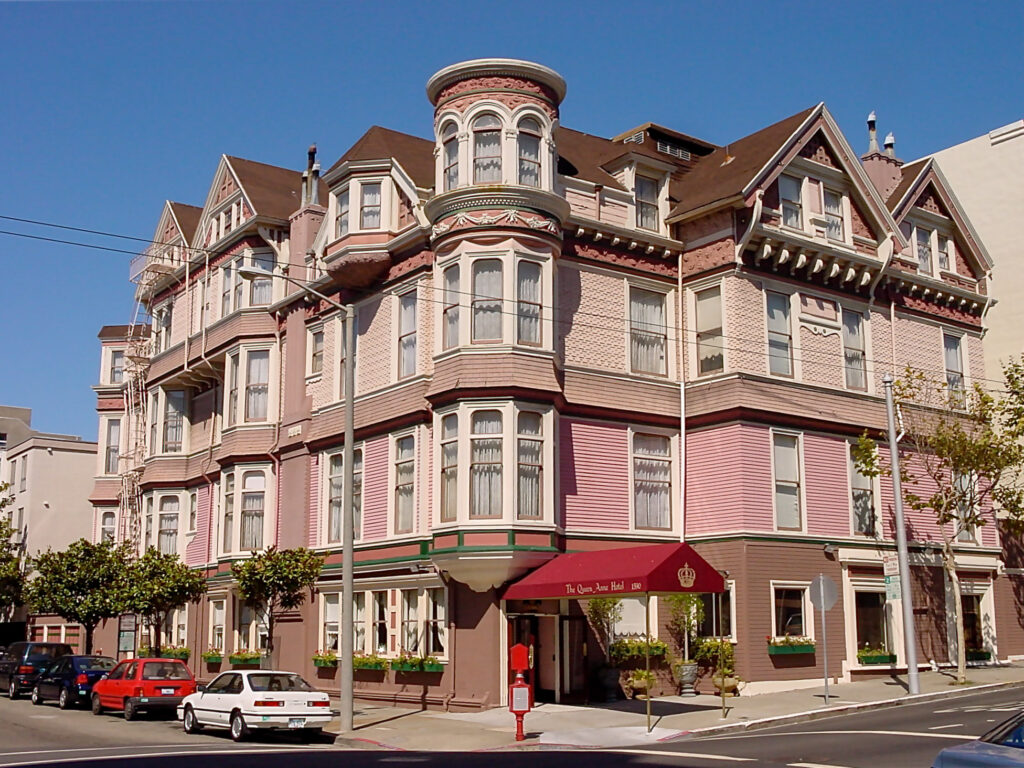
Tucked away on a quiet corner of Nob Hill, the Queen Anne Hotel does not immediately suggest a haunted reputation. Painted a soft pink and framed by neighboring residences, it appears quaint rather than foreboding. Inside, however, the atmosphere shifts. The richly detailed Victorian interior feels preserved in time, and many visitors report a sense that the building is quietly occupied—welcoming, but attentive.
The structure was built in 1890 and has served several purposes over the course of its history. In its early years, it operated as a girls’ boarding school under Mary Lake, commonly referred to in period newspapers as the Lake Seminary. Although much has changed within the building and the surrounding neighborhood, stories of its former headmistress have endured.
The school’s founding has often been attributed to James Fair’s family, however no surviving public records could be located that clearly document whether his daughters ever attended. Theresa (“Tessie”) Fair married in 1890, and a San Francisco Chronicle item from November 1891 places both Fair daughters in New York, details that make later claims of their enrollment difficult to confirm on timeline alone. Contemporary accounts instead suggest that Fair’s involvement may have stemmed from his friendship with Mary Lake’s father, Judge Delos Lake. While some later sources have asserted that the school existed specifically for Fair’s daughters, that claim appears to rest on repetition rather than documented evidence and should be regarded as part of the site’s evolving folklore.
Mary Lake herself was known as a devoted and exacting educator. She reportedly maintained strict standards for her students, carefully regulating visitors and insisting that young women leave the school only under proper supervision. Former students are said to have remembered her fondly, describing her as firm but deeply caring, qualities that would later shape the character of the stories told about her.
The school closed after only a few years of operation, and Mary Lake subsequently left San Francisco. She died in Montclair, New Jersey, in July 1904, leaving behind a reputation shaped largely by memory rather than record. A later San Francisco Call-Bulletin article from November 1904 describes former pupils planning a memorial and notes that she had “died in July of this year,” underscoring how strongly she was remembered within the city’s educational community.
In the decades that followed, the building changed hands multiple times. It was not until the 1980s that it was restored and reopened as the Queen Anne Hotel. Since then, reports of unusual activity have become closely associated with specific areas of the property, most notably rooms 410 and 414. Room 410, believed to have once served as Mary Lake’s private quarters, is most frequently mentioned.
Guests staying in these rooms have described experiences that are notably gentle in nature. Some report returning to find their belongings neatly arranged, pillows replaced, or covers tucked in during the night. Others describe localized cold spots or the quiet sensation of being watched over rather than disturbed. The figure associated with these accounts is consistently described not as threatening, but as attentive.
Whether these experiences are interpreted as paranormal or psychological, the stories surrounding Mary Lake have become inseparable from the building itself. Rather than inspiring fear, they reinforce the impression that the Queen Anne Hotel is a place where the past has not entirely withdrawn, where care, routine, and memory still quietly persist.
For many visitors, the appeal lies not in encountering something frightening, but in staying somewhere history feels unusually close at hand.
Editor’s note: Research for this story began with an on-site visit to the Queen Anne Hotel in September 2002 and involved consultation with archival sources. The version presented here has been lightly edited for clarity and archival consistency.
Sources: San Francisco Examiner (July 18, 1904; July 19, 1904), Oakland Enquirer (July 19, 1904), San Francisco Call-Bulletin (Nov. 23, 1904).